
Finding Your Ikigai
The Man Who Wanted To See It All
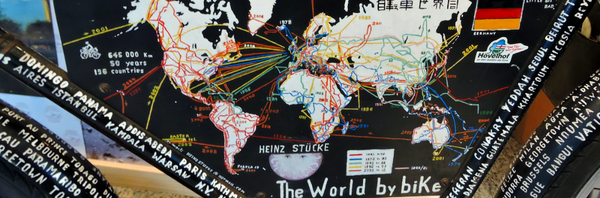
I recently stumbled across a documentary titled, The Man Who Wanted To See It All. It told the story of Heinz Stücke, in 1962 he left Germany and set off on a bike ride touring the world which spanned close to 50 years and covered enough distance to circumnavigate the world 15 times around.
What I found striking about this documentary is that Heinz did not set out to be the best cyclist, or the best photographer and any records that he broke were seemingly a welcomed accident. His soul focus and purpose were set on experience, connection, seeing and being. After leaving his home town in 1962, Heinz decided to not return home as he deemed going home as the end of his adventure. After over 50 years of nomadic living, this is where the documentary found its focus.
The documentary shows Heinz putting his memories in order and sorting through his tens of thousands of photographs, reuniting with family and friends and reflecting on his achievements and sacrifices. Something that has stuck with me since watching this documentary was how his friends spoke of his life journey. Friends from childhood reflected on his journey with great solace, they asked the question “I wonder if he is happy?”. The conversation felt heavy and remorseful. In contrast, the family that grew close with Heinz in Japan spoke of Heinz and his journey with tremendous joy and fascination, they remarked that Heinz had achieved Ikigai. But what is Ikigai and how do you find your ikigai?
“I consider myself a treasure trove, what I hope of the day is that it gives me the pleasure of finding something new” – Heinz Stücke: Home is Elsewhere.
What is ikigai?
Ikigai roughly translates to, a reason for being. The word itself is composed of two worlds: iki, which means life and gai, which describes value or worth. The word can be used similarly to happiness but ecompasses a deeper nuance. Ikigai is also about discovering your purpose and aligning your actions with this. If you have a clear sense of purpose, you can then align your sense of purpose with your values and goals.
By thinking of ikigai in relation to Heinz, it’s easy to assume that to achieve it you must do something extraordinary, however the true meaning of ikigai is rooted in the ordinary. Ultimately, this practice allows for moments of happiness in each day, you can find meaning and joy in even the most mundane tasks.
“I found the way of life I enjoy, and what is better than to follow a life which is fulfillment. The journey is my fulfillment.” –Heinz Stücke: Home is Elsewhere.
Using ikigai as a tool
In Western society, ikigai is seen as a tool to achieve a long and happy life. A google search will show you a plethora of venn diagrams on how to achieve it with four overlapping qualities: what you love, what you are good at, what the world needs, and what you can be paid for.
This Western approach includes work and payment which isn’t necessarily the truest adaptation of the meaning. At its core, ikigai is as simple as finding out what makes you happy each and every day. When you ask yourself questions around the principles of Ikigai it is vital to curate answers about you and your soul, not your work.
Of course I agree that you can align the principles of ikigai with your working life in order to achieve happiness and satisfaction in all meanings of the words. Nevertheless, I think it is wrong to consider your work when asking questions around ikigai. Ikigai is deeper than your work, it is about you, your inner being and how to nourish your soul. Once you have answered these questions honestly, you can then apply these to your work practice.
“Japanese people believe that the sum of small joys in everyday life results in more fulfilling life as a whole”- Yukari Mitsuhashi
Asking the right questions to find your Ikigai
Your life is not limited to your work. It is only possible to find ikigai in your practice if your work’s values and ethics align to your own, your work must also actively nurture your personal growth and wellbeing. There is nothing wrong with the Western adaptation of ikigai and it can be used as a powerful tool to navigate and curate your working life.
Regardless, I think we should break away from ‘Ikigai in the workplace’ and instead keep it simple. It is far more powerful to get in touch with yourself. If you can find something in the everyday that makes you happy, brings you joy or a sense of awe you too can find ikigai. No matter how big or small.
-
- What lifts your spirits?
- What gives you a feeling of awe?
- What are small things that you cherish?
- What gives your life meaning?
- What might you want to contribute?
- What are you doing when you lose track of time?
Write down your answers to these questions and actively incorporate the answers into your everyday life. This is how to find and nurture your Ikigai and lead a happier and fufilled life.
“essentials to happiness in this life are something to do, something to love, and something to hope for.” – Hector Garcia, The Japanese Secret to a Long and Happy Life.
Helpful Links
To read more about awe, click here.
Want to find out more about Ikigai, click here.
To find out more about Hans Stücke, click here.
We post new blogs every month. To see more, click here.
Join us for our next Tribe Talks with Rise of Happiness to help create your path to happiness. To book your free ticket, click here.
Share your thoughts and keep in touch by signing up to our newsletter below!
Thanks for reading,
Alice.
Mailchimp signup form
Playing With Creativity to Find Fun
Why should we add creative play into our lives to find fun?
“It is in playing and only in playing that an individual is able to be creative and to use their whole personality, and it is only in being creative that the individual discovers the self.”
― Donald Woods Winnicott, Playing and Reality
Creativity is unique to each individual, it encapsulates many different forms, processes and connections. Creativity and play can generate an important challenge; embracing fear and your inner critic. We lose interest in hobbies as we grow older, arguably this is as they need to hold a greater meaning than ‘just for fun’. Spending our precious time on something, anything, must produce a worthy outcome and once play is lost from our lives, it is difficult to regain.
A quick google search of the word ‘play’ will primarily show images of children playing, but it is just as important for adults to play too! The further removed we become from the idea of play, the more troubling the idea becomes. A purposeless activity becomes a concept that is impossible to grasp and often causes feelings of awkwardness. The average person has up to 60,000 thoughts a day and creative play has been shown to help focus the mind. Creative play and finding your flow can reduce anxiety, depression and stress. So why is it so alien to us?
Using Creative Play to find Flow
Flow is a state of mind achieved when you are fully engrossed in an activity. When you lose all sense of self and time, that’s flow. It’s been found that repetitive creative tasks can help you find your flow, tasks such as writing, knitting and drawing are great examples of this. Once you have achieved a state of flow, your brain becomes flooded with dopamine, the feel good chemical that helps to motivate you and ultimately will encourage you to repeat your chosen form of play.
“…It is when we act freely, for the sake of the action itself rather than for ulterior motives, that we learn to become more than what we were.”
― Mihaly Csikszentmihalyi, Flow: The Psychology of Happiness
Using Flow to encourage Play
Having fun with creative play is often seen as a nice idea, but we are at a loss as to where to start. For most people, it’s been so long since they last played, they have forgotten altogether how to do it. Whilst it is a nice idea, we are no longer sure what it means to play. In the words of Maya Angelou, creativity is a bottomless pit: ‘The more you use it, the more you have’. Creative play becomes even more important as we age and as our lives get busier. When embracing play, it is important to remember that the act of play must be deemed as being more important than any form of outcome. Most of all, creative play should bring you joy, you should engage in play to immerse yourself in a moment to moment experience.
“Life without play is a grinding, mechanical existence organized around doing the things necessary for survival.Play is the vital essence of life. It is what makes life lively.”
― Stuart Brown, Play
Growing Down to find Fun!
Often, we recognise that people benefit from free spirited play such as dancing, scribbling or writing but cannot see the point in engaging in it ourselves. Art in any form wears a veil of elitist mysticism. If you view yourself as an ‘outsider’ to the culture, it becomes even more difficult to engage with it. Instinctively, we lean into these feelings of imposter syndrome by becoming more concerned with the physical outcome than the positive internal feelings the act brings us. Creative play is not about making great art, or a great piece of writing, it’s about finding your flow and happiness.
I think sometimes we need to grow down, free ourselves from the constraints of what it means to be an adult. Let yourself indulge in silly fun and stop thinking about what is and isn’t possible. Be in the moment, open your mind, find your flow and remember, the act is more important than the outcome.
Need Some Inspiration?
- 100 day challenge
- Attend a local Workshop or a Class to help with inspiration and motivation. (The first time is always the hardest)
- Take 20 minutes of each day to play, this could be through free writing, doodling or playing a game.
- Move your body, pop on some tunes and have a mid-afternoon boogie. Don’t be shy!
- Most importantly, decide what fun means to you and make the time for it.
Share your thoughts and keep in touch by signing up to our newsletter below!
Thanks for reading,
Alice.
Mailchimp signup form
Finding flow in 2022
Wait, what year is it?
I think we are all feeling the strangeness of 2021. I accidentally wrote an email out to everyone at Tribe saying we should say good bye to 2020. Many of us are saying last year doesn’t count, but it does. And most likely in ways we don’t yet understand.
We have somewhat transitioned out of the high alert state and into life with normalised constant threat and high potential of change. Life with both feelings of normalised loss and at the same time, new levels of appreciation of things that used to be taken for granted. The constant stress of playing out the worst case scenarios is exhausting. With burnout hovering over or perhaps already landed for you, this year has been full and dull.
According to Adam Grant,
“We just felt somewhat joyless and aimless. It turns out there’s a name for that: languishing. Languishing is a sense of stagnation and emptiness. It feels as if you’re muddling through your days, looking at your life through a foggy windshield. And it might be the dominant emotion of 2021.
Psychologists find that one of the best strategies for managing emotions is to name them. Last spring, during the acute anguish of the pandemic, the most viral post in the history of Harvard Business Reviewwas an article describing our collective discomfort as grief. Along with the loss of loved ones, we were mourning the loss of normalcy.”
Simultaneously, I have had countless conversations with people expressing how they have found new levels of awareness and a better pace for life since Covid. Usually that is quickly followed up with how bad they feel about saying that when they know many people have suffered so greatly. I have caught myself saying that too. I liken this to hitting rock bottom and the perspective that gives you- the only way is up.
What can we do about it? What to seek in 2022.
I purpose going against the cultural norm of numbing and leaning into meaningful acts. Adam describes this as flow- that elusive state of absorption in a meaningful challenge or a momentary bond, where your sense of time, place and self melts away. Grant goes on to site a study of flow;
“During the early days of the pandemic, the best predictor of well-being wasn’t optimism or mindfulness — it was flow. People who became more immersed in their projects managed to avoid languishing and maintained their prepandemic happiness.”
Finding flow is becoming increasingly more challenging. We have a million things pulling at our attention all of the time. It takes a huge amount of discipline to stay focused. But a distracted mind is the enemy of flow.
I have noticed that when I am feeling a bit low, I check my emails more often and I scroll through my social channels in a mindless way. Now when I catch myself in this state, I take a moment to try and think about what is really bothering me. Sometimes it is easy to figure out, sometimes, all I can do is change my habits. I notice that behaviour now and stop. I find something more focused to do- even if that thing is to sit and do 4 mindful breaths. I disrupts the bad habit, one tiny task at a time.
One characteristic of flow is the act of complete concentration on one task.
This can come in many forms and probably why I crave playing cards or board games from time to time. They create a contained task that my mind can concentrate on. No need to think about the ever growing to do list or what I forgot to do or what I need to think about putting on my to do list. Although finding an effortless state and flow are different, it is a good place to start.
More about FLOW
Csikszentmihalyi describes eight characteristics of flow:
- Complete concentration on the task;
- Clarity of goals and reward in mind and immediate feedback;
- Transformation of time (speeding up/slowing down);
- The experience is intrinsically rewarding;
- Effortlessness and ease;
- There is a balance between challenge and skills;
- Actions and awareness are merged, losing self-conscious rumination;
- There is a feeling of control over the task.
Flow state is losing yourself in the moment; when you find your abilities are well matched to an activity, the world around you quietens and you may find yourself achieving things you only dreamt to be possible.
To me that sounds worth the effort and at least one way of approaching 2022; an antidote to some of 2021’s languishing.
 Top
Top